Learning Objectives
Review how the multiple paths in the history of artificial intelligence have diverged and converged, understand how "The Reconvergence of Multiple Paths to Intelligence" explains EvoX's technical lineage, and distinguish the distinct problem切入点 that symbolism, connectionism, cybernetics, and evolutionary computation each address.
Core Concept: The Reconvergence of Multiple Paths to Intelligence
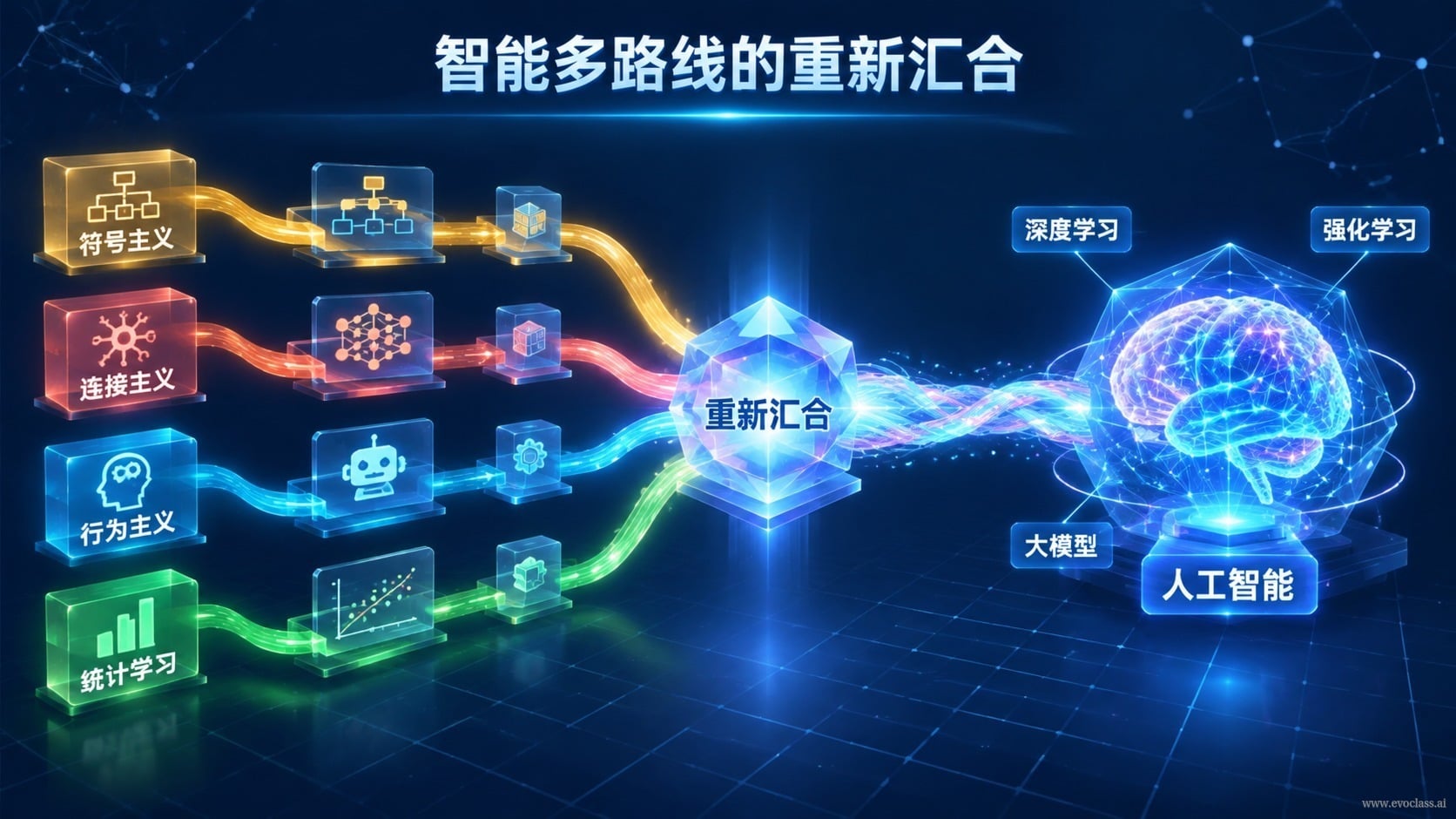
Artificial intelligence has not evolved linearly along a single path. Symbolism, connectionism, cybernetics, and evolutionary computation once started from different problem切入点, each exploring knowledge representation, problem understanding, action feedback, and diversity preservation respectively. Modern intelligent systems must confront open environments, long-term accumulation, and complex decision-making, and therefore need to reintegrate these traditions rather than covering all intelligence problems with a single paradigm.
The Emphasis of the Four Paths
- Symbolism: Emphasizes explicit knowledge representation, logical reasoning, and rule constraints; well suited to explaining how knowledge is represented and manipulated.
- Connectionism: Emphasizes learning patterns and representations from data; well suited to handling high-dimensional mappings in problem understanding and perception generation.
- Cybernetics: Emphasizes feedback, regulation, and action loops; well suited to explaining how systems continuously correct behavior within an environment.
- Evolutionary Computation: Emphasizes population search, variation generation, environmental evaluation, and diversity preservation; well suited to open-ended exploration and optimization across multiple candidate solutions.
The Meaning of Convergence
Convergence does not mean simply adding the four paths together, but rather having them play complementary roles within the same intelligent system: symbolic rules provide constraints and interpretability, connectionist models provide perception and generation capabilities, cybernetic feedback provides action correction, and evolutionary search provides open-ended exploration and diversity. Only in this way can a system continuously evaluate, select, correct, and inherit amid environmental changes.
EvoX's Positioning
EvoX's technical lineage sits precisely at this convergence point. It is not a tool that grew out of a single path alone, but a practical framework that builds an evolutionary closed loop between model capabilities and system capabilities. Among these,Evolutionary Computationis the most direct technical source: rather than pre-specifying a single answer, it seeks balance through variation generation and environmental evaluation, while preserving diversity.
Core Terminology
Evolutionary Computation: An open-ended search tradition whose core mechanisms are population, mutation, selection, and inheritance.
Swarm Intelligence: The ability to solve problems beyond that of a single individual through the parallel exploration and interaction of multiple individuals.
Diversity: Preserving different candidate solutions and exploration directions to avoid premature convergence to local optima; this is key to sustained adaptation in open environments.
Key Takeaways for Learners
Understanding this historical convergence background is a prerequisite for understanding the subsequent EvoX intelligent evolution system and AI Native research practices. When you encounter a large model application, you can ask: Does it only perform single-shot generation? Does it have environmental feedback, evaluation and selection, long-term inheritance, and diversity preservation? If not, it has not yet completed the system-level closed loop of multi-path convergence.
Structural Diagram of Multi-path Convergence in the History of Artificial IntelligenceObserve the structural diagram of multi-path convergence in the history of artificial intelligence, and consider how it relates to "The Reconvergence of Multiple Paths to Intelligence."